#Trinity60
Robin Wilson Obit

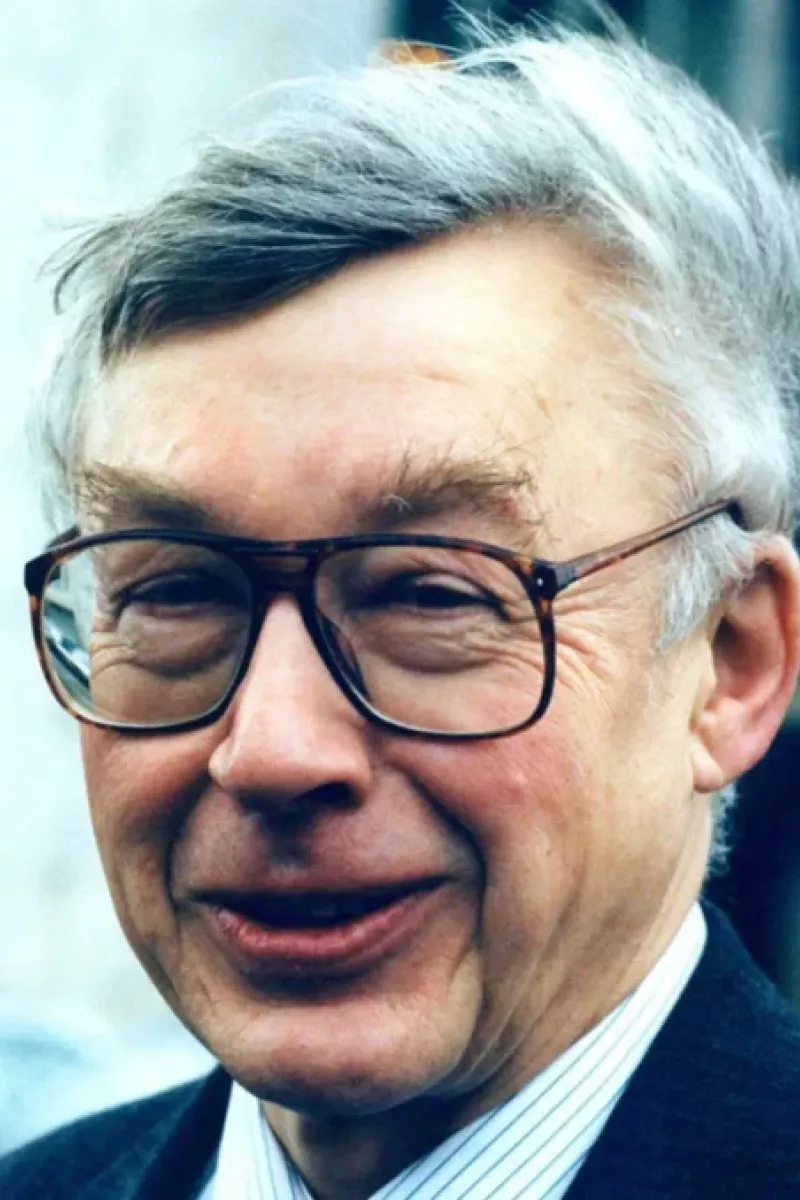
Robin Wilson (1933–2024)
It is with great sadness that we announce the passing of Robin Wilson, former Headmaster of Trinity School, who served the school with remarkable dedication and vision from 1972 to 1994.
Born in 1933, Robin's journey was one of intellect, creativity, and leadership. A scholar of French, German, and English Literature at Trinity College, Cambridge, Robin embarked on a career that spanned education and cultural exchange, starting at University of Muenster in German and managing a British Council Anglo-German Centre. Returning to England, he contributed to the historic St Peter’s School in York and later joined Nottingham High School as Head of English before taking on the role of Headmaster at Trinity School.
Robin began his tenure at Trinity during challenging times but immediately set about enhancing the school’s reputation and facilities. His commitment to fostering excellence in education saw him focus on religious education, arts, and technical studies, while also leading extensive building projects that have left a lasting legacy. Among these were the Berthoud Centre, the Turner Building, the Shaw Building, and the expansion of the library into the Wilson Library.
Under his leadership, Trinity School thrived, achieving intellectual and sporting successes, including the school’s notable triumph in the National Independent Schools Challenge Trophy (a schools general knowledge version of Top of The Form) in 1977 and a record-breaking rugby season in 1990-91. Robin also embraced the arts, producing school dramas and children’s operas and engaging actively with the alumni theatre group, The Mitre Players. It was Robin’s deep support for the Trinity Boys Choir that led to the Midsummer Night’s Dream and Glyndebourne Opera relationship blossoming and the burgeoning musical reputation that the school still enjoys today.
Robin was a unifying figure in the education community, forming the Trinity Group of Headmasters to collaborate on shared challenges and became Chairman of the Headmasters’ Conference in 1993. His influence extended beyond his retirement, as he conducted school inspections and supported local charities, including the becoming Chairman of the Croydon Branch of the National Society for the Prevention of Cruelty to Children (NSPCC), and always with his wife Caroline, herself a headmistress of a primary school, alongside.
A keen golfer, Robin enjoyed his membership at The Addington Golf Club, where he served as Captain and chronicled its history for the centenary celebrations. He was also a much-loved member of the Trinity Golf Society. He won the Pairs Knockout competition with his long-standing partner, Gerry Murphy and was its President from 2002-2005.
Robin’s unwavering energy, dedication, and care for others left an indelible mark on everyone he encountered. He will be fondly remembered as an inspirational leader, a devoted family man, and a steadfast friend to many.
Robin is survived by his daughters Kate and Olivia, who shared in his many adventures and achievements. His legacy lives on in the generations of students and colleagues who were privileged to know him and in those who are currently enjoying the many wonderful facilities at the school.
Rest in peace, Robin Wilson.
Robin's eulogy
Of the several Headmasters I encountered at various schools, Robin stood out as by far the most humane and considerate, and it is on this aspect that I intend to concentrate particularly in this tribute to him.
When Robin arrived as Headmaster of Trinity he was relatively young by the standard of Independent schools at the time. I understand that there were some long established members of staff who doubted his ability to take the school forward. How wrong they were.
When changes were being planned for Trinity, Robin always considered very carefully their potential impact, not only on the pupils and the teaching staff, but also on other staff vital to the smooth running of the school - porters, secretarial and ground staff for example. Sometimes this resulted in a delay but also a better outcome.
And there were of course many changes.
Early in my time, one of the most productive, in my opinion, was the creation, in the Sixth Form, of a Tutor Group system where pupils shared one of their subjects with the tutor. This replaced the former division into form groups, largely for registration and administration, and thus enabled a much closer association between administration and pastoral care.
When the Government Assisted Places scheme came to an end Robin played an important part in the establishment of the Trinity Bursary Scheme that has progressively allowed students from homes with more limited means to benefit from what Trinity has to offer.
Robin was instrumental in the establishment of the Trinity Group, primarily to facilitate meetings between Headteachers in the South London area to discuss matters of mutual interest. This was then extended to holders of comparable roles in the participating schools, Heads of Departments for example.
Later in his career at Trinity Robin's achievements as a Headmaster were recognised by his election to serve as Chairman of the Headmasters' Conference, the only Whitgift Foundation Head to be recognised in this way, to date.
There were also several significant building projects, the Wilson library, so named after his retirement, the Berthoud Centre for music, the Shaw Building, including the Mitre Theatre and associated teaching areas, and the Turner Building with its fine array of athletic facilities as well as a new Art Department and provision for Design and Technology.
At times, one might have wondered whether Robin had time for anything else - but he did. He was a keen golfer at Shirley Golf Club and more than held his own on the squash courts. He also had time to represent the staff cricket team, the Pedants. He often opened the batting and was also an occasional spin bowler: I am unable to verify the allegation that, when he came on to bowl at Blindley Heath, the captain stationed a fielder at deep mid-wicket – in a field on the opposite side of the A22.
He and Caroline enjoyed playing Bridge, often with or against other members of staff: on one occasion it is alleged that a teacher of German, finding himself holding a hand with few merits, announced his intended next card in terms that reduced Robin, and particularly Caroline, to uncontrollable laughter.
Robin involved himself in Drama, producing school plays and childrens' opera such as 'All the King's Men', and occasionally took a part in the Mitre Players' Christmas Pantomime, where his part as King Arthur in Sir Merryman required him to receive a custard pie full in the face: this he accepted with the same good grace as he did the humour of the annual Staff Revue where, inevitably, the Headmaster was the butt of a fair proportion of the jokes.
Robin introduced, supported and participated in an annual trip to Oxford or Cambridge in alternate years to visit and dine with ex-students then in residence. Arriving back at Trinity late one evening, we found the gates locked and, as we were discussing how to proceed, a police car pulled in behind us: an officer approached and enquired why we were there and what we intended. Robin resolved matters by announcing firmly, and quite loudly, 'I am the Headmaster' – though this did not unfortunately cause the gates immediately to open.
One of the more important tasks of a Headmaster is to hand over to his successor. He reported that he had been advised to prepare three envelopes, the first to be opened when problems first arose, advised 'blame your predecessor', the second, when things become more difficult, read 'blame yourself' and apologise, and the third said 'prepare three envelopes'. I cannot confirm whether Robin did hand three envelopes to Barnaby Lenon.
To return to the theme of humanity and consideration, a colleague who joined Trinity at the same time as me became one of Her Majesty's Inspectors of Schools and found himself involved in the inspection of a well-known independent school in North London where Robin was the Lead Inspector. My colleague was struck by Robin's clear vision of what the best education should look like: in arriving at judgements he did not set out to find fault or condemn. Having laid out how he wanted the inspection to run, he let his team get on with it and advice was offered to younger inspectors with empathy and good humour.
He and Caroline were kind to colleagues going through difficult times: one of us, having lost his father, enjoyed the use of a cottage in Wales, then owned by Robin and Caroline, for a holiday with his grieving mother.
Shortly before his death, Robin was able to attend, with his carer, a lunch time gathering at a local hostelry with some of the Old Lags, as ex-members of staff term themselves. He also enjoyed photographs from the past that sundry colleagues took round to his home in Beech House Road.
In preparing these words I feel deeply indebted to several of my ex-collegues who, without exception, were keen that I should emphasise Robin's generosity of spirit.
He and Caroline were in a very loving and long-lasting partnership and it was probably unsurprising that both of their lives came to an end within a few days of each other.
Robin was a wise and thoughtful human being and we are all the poorer for his passing.
Tim Cattell