#Trinity60
Jack Griffin obituary

Jack was from Maidstone and attended Maidstone Boys’ Grammar School. When he left school, he had to earn money to pay for his elder brother to go through theological college, so became a bank clerk, a job he did not enjoy. He was called up for WWII, was at Dunkirk and Normandy, serving in France, Holland and Germany. He found that many of the men serving under him in the army were illiterate and he began English classes for them, subsequently realising that he wanted to become a teacher. After demobilisation, when there was a desperate shortage of teachers in the country, he did a compressed course at Worcester teacher-training college. His first post was at Purley Grammar. When a job came up at Trinity, an Australian friend, Ken Merry (then teaching Physics at Trinity and who is still alive in Melbourne – we know him, his children and grandchildren), went to see Oliver Berthoud and said he knew a good man for the post. Jack was duly appointed, began work at Trinity in 1952, and loved every minute of his long career there.
Address about Jack Griffin by the Very Reverend David Brindley, 3 July 2007
Though he was to be a father figure to so many, Jack never knew his own father, who died in the Spanish ’flu epidemic of 1918, leaving his wife pregnant and with a two-year old boy, Rutland, Jack’s brother, happily with us today. Brought up by his mother, to whom he was devoted, Jack was educated at Maidstone Grammar at the expense of the Masons, a debt he acknowledged all his life. As a young man he loved walking in Kent, and acquired a love and knowledge of nature which he passed on to others.
At school he excelled at sport, especially rugby and cricket, and, as he was to do all his life, made lasting friendships. He was good at attracting and nurturing friends—grappling them to himself with hoops of steel.
There was no money in the family that might have allowed him to stay on at school or go to college and so he left as soon as he got his School Cert in 1935 school and he went into the National Provincial Bank as a clerk. It was a job he loathed, and we perhaps heard an echo of that loathing in the 1960s poem Harriet has just read. Jack was saved by the war. He and another colleague from the bank went down to the Recruiting Office one lunchtime, signed up, and delighted in the petulant accusations of desertion made by the boss who had for years made their lives a misery.
Many of Jack’s schoolfriends were also conscripted into the West Kents and the plan was that they should all be privates together. Many of them, including Jack, were part of the British Expeditionary Force, the survivors struggling back from Southern Belgium in 1940 to gather at Dunkirk. There their TA officers abandoned them. Others have told us how Jack took charge of a group of comrades on the beach and in the dunes, keeping their morale up while they were repeatedly strafed by the Germans as they waited for a boat home (in Jack’s case a paddle-steamer). He evinced an absolute disdain for these officers, who had lorded it over their men but, when the chips were down, had scuttled back to Blighty at the first opportunity, leaving them to their fate.
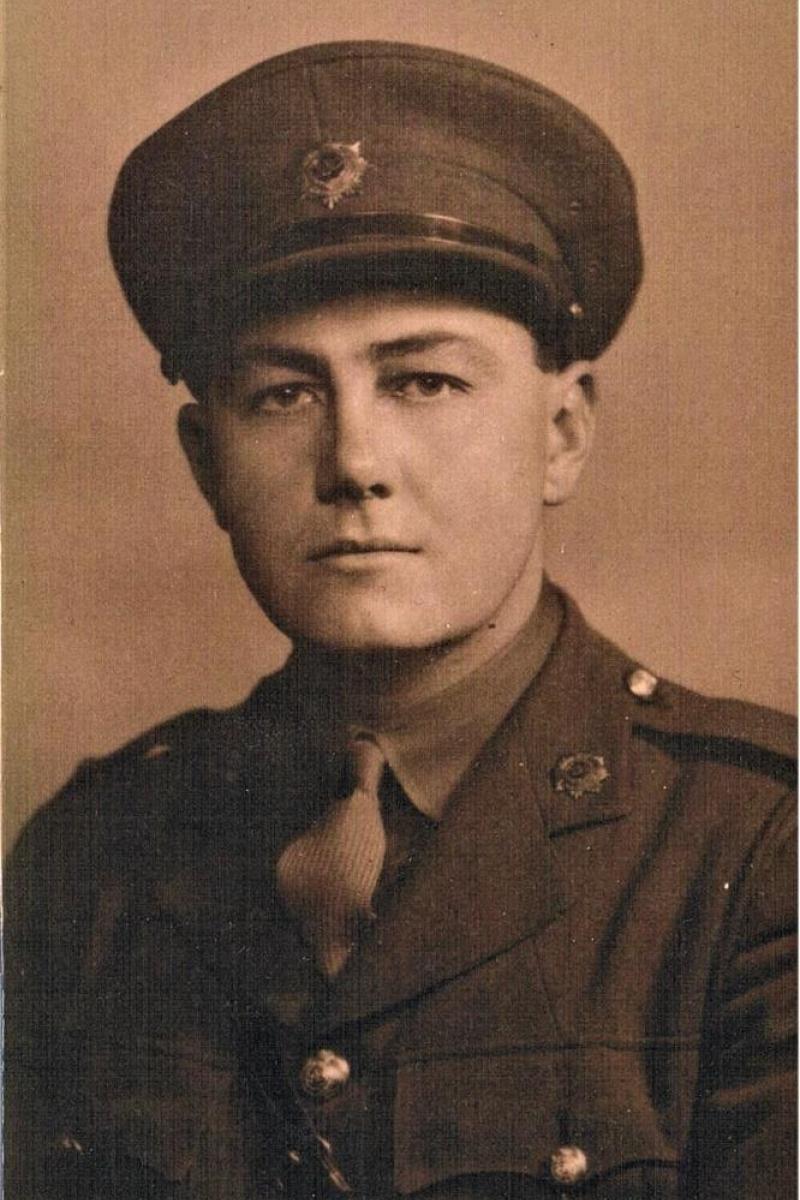
Back in England, Jack was sent for officer training and eventually he took part in the Normandy landings, being seconded to the 6th Guards Armoured Brigade where it was his job to organize supplies to the tanks. Twice mentioned in despatches, he was part of the Normandy breakout and advance through the Falaise Gap, and was involved in the liberation of Holland. The Dutch friends he made at the time he kept all his life, Shelagh and he putting in a surprise appearance only a few years ago at a 90th birthday party in Eindhoven.
Eventually, Jack became part of the occupying forces in Germany, where he was posted to Portz, near Cologne, supplying the local population during the dreadful winter that followed the capitulation of Germany. A photograph from those days shows that he had at his disposal a motorcycle and a speedboat, neither of which he would be able to afford again on the salary of the schoolmaster he was soon to become.
Jack and Shelagh had known each other as teenagers and they married in 1943, enjoying more than 60 years of very close companionship. Theirs was a very loving and stable marriage.
In the War, Jack had realized how poorly educated were many of the men who served under him. He ran impromptu English classes for those who were illiterate and in so doing discovered that teaching was his calling. Although invited to stay on in the Army (he was by then an acting Lieutenant-Colonel), he chose demobilization in 1946 and went to Worcester Training College for an accelerated 18-month course. There he became Student President, and, in August 1948, took the part of Macduff in the end-of-course student production of Macbeth. His Maidstone housemaster had written of Jack as exercising ‘a wholesome influence in the House and School’, a sentiment echoed in the Testimonial from the President of the Training College : ‘He has all the qualities which go to make a schoomaster of the best and most endearing type’.
His first job was teaching English and what was then known as Religious Knowledge at Purley Grammar, which he loved and might never have left had it not been for the encouragement of an Australian teacher, Ken Merry, who had worked with Jack at Purley before moving on to what was then The Trinity School of John Whitgift. It was Ken who encouraged Jack to apply to Trinity and recommended him to the then Headmaster, Oliver Berthoud, who had the good sense to recognize that the best teacher might not be the candidate with the best paper qualifications.
So, Jack arrived in Trinity in 1952, and there he stayed until retirement, becoming Head of the Junior School and a pillar of the whole establishment. He was involved in everything: for many years co-producing school plays (he enjoyed acting), running school teams, and much else besides. Although the demands of school matches meant that he had to sacrifice his own Saturday club cricket, cricket remained his first sporting love. He gleefully recalled the occasion when, as a trainee teacher, he skipped a lecture on Chaucer in order to see the 1948 Australians, skippered by the great Don Bradman—play at the lovely County Ground. The prickly lecturer whose class had been cut complained to the Principal, who summoned Jack to explain where he had been. They were soon comparing notes on the innings, as they had both bunked off to see the great man and his ‘Invincibles’.
So many of those who have written to the family over the last ten days have mentioned Jack’s sense of humour. The staff reviews for which he wrote song lyrics were legendary, and he seemed always to be surrounded by laughter. Colleagues have mentioned how, in the old school buildings in North End where many classrooms were divided by wooden partitions, there were eruptions (or interruptions) of their own classes by gusts of laughter from the other side of the partition. And not only laughter. As one ex-pupil wrote, ‘To Jack, I owe an understanding of nouns, verbs, adjectives, and adverbs and I can still see him in front of the blackboard, chalk in hand, bracketing the subordinate clauses. A moment later, that same chalk became a heat seeking missile, launched with deadly aim at the less attentive.’
Laughter and chalk were not Jack’s only weapons as a teacher. A man of absolute integrity, he was an unfailing source of sound, humane advice: firm when he had to be, but always scrupulously fair. A model, in fact, of what a teacher should be. He detested hierarchies, and pretension, and was quick to deflate pomposity wherever he found it, even discouraging correspondents from using his old Army rank, as was then the fashion. He was interested in people, not their station.
And he found practical ways to help them. Pupils became friends and many have written to say how he helped shape their lives. And, at Trinity, he and his great friend Geoff Evans decided that the CCF might not be the ideal extracurricular activity for every boy in the School, and so, with the blessing of Oliver Berthoud, they set up Community Service, giving boys experience of helping the old and handicapped. After retirement. Jack worked as a volunteer with both the Citizens Advice Bureau and Croydon in Need.
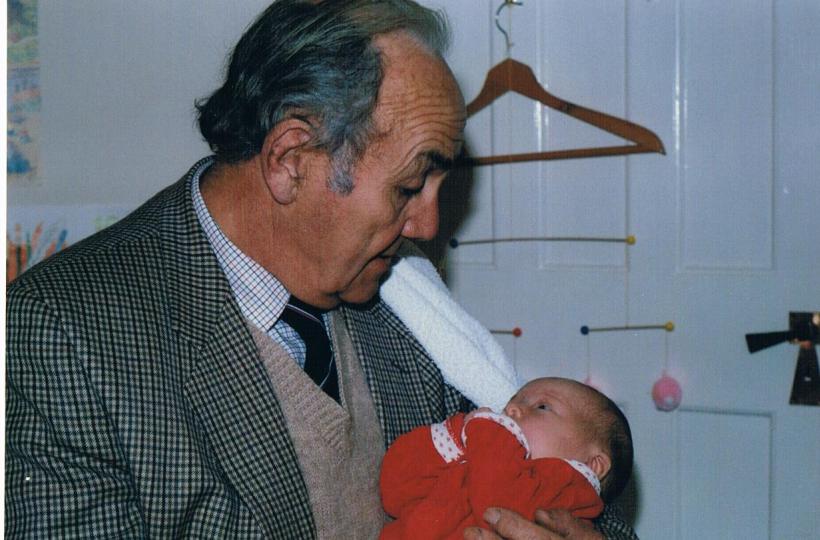
A wonderful parent, he adored children. His cup of happiness ran over when he had three grand-daughters, whom he idolized, and, even in the last year, his face would light up on entering a room if he discovered the presence of small children.
Some forty years ago, Jack wrote a small piece for a parish magazine, entitled ‘Being a Schoolmaster’. Let me quote, briefly, from that article, as it seems to sum up Jack’s attitude to his job and to life itself. ‘There is no doubt that the profession is a satisfying one for any person who feels he wants to measure his life in terms of people rather than in terms of profit and loss accounts or in terms of output. If children are to find themselves, they must be allowed a sufficient degree of freedom. If they are to develop their powers to the fullest they must be prepared to accept the appropriate discipline and training. The maintenance of this balance is a vital part of the schoolmaster’s job. To a great majority of pupils, the senior school is the last stage of school life, and it is a heavy responsibility for a sincere teacher to feel that upon him lies the burden of teaching things that will endure once school life is finished. When school is over, only those activities will endure which have acquired a sufficient momentum through a long period of self-direction and independence. It is the hand of the teacher which will guide the pupil towards fulfilment. It is his responsibility to direct, to advise, to help.’
I should not wish to close this short tribute without mentioning Australia. For Australia became an important part of Jack and Shelagh’s life. Back at Purley Grammar in 1951, Ken and Dawn Merry had been their first contact with Australia, and the friendship they formed at the time blossomed and lasted until Jack´s death, as did their early friendship with Leigh and Joyce Speedy. All Ken and Dawn’s children stayed at Russell Hill at one time or another and there were always letters from Australia on the doormat. Jack and Shelagh never thought they’d go to Aussie, but, in the end, they had three trips to Melbourne, and Jack did a term’s teaching exchange there. Characteristically, he and Shelagh made countless Australian friends, many of whom join us now from half-way round the globe. They have asked when exactly this service is taking place so they can be thinking of Jack now.